
A Different Census
Jesus, Bruegel the Elder, and Harper Lee's best Christmas

Welcome to my newest readers, fellow bibliophiles, and educators!
Before the mountains were born, before you had formed the earth and the world, from eternity past to eternity future you are God. —Psalm 90:2 (CJB)
Our everlasting God is not confined by time. Neither is Christ’s birth.
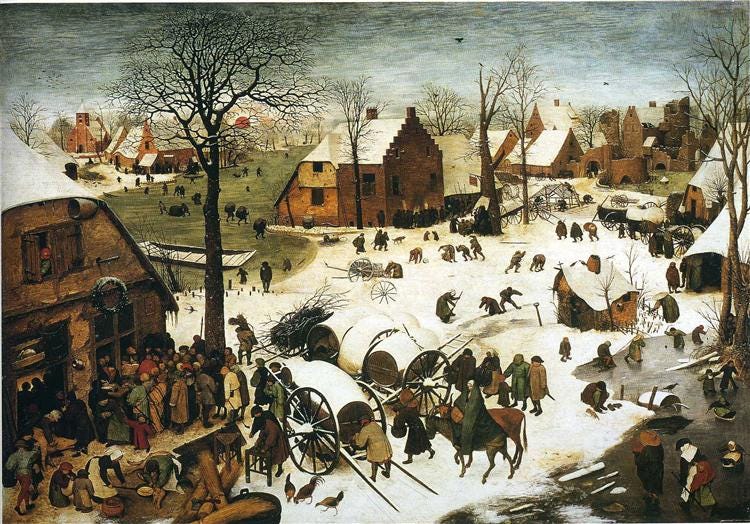
Bruegel’s snowy panorama is a Flemish village in winter, but it is also Bethlehem. The sun rises in the background, and the Christmas vigil will begin before nightfall. Filled with activity, the village is like a historical inventory of daily life. Children play with tops, throw snowballs, or slide on the ice. Carts shaped like giant barrels are loaded with grain sacks. A man ties on his ice skates. The crowd gathered by the tavern in the foreground wait to give money, probably to a tax collector, while another collector fills out a register. Joseph and Mary approach the inn to join the line.
Among many historical details present in the scene, Bruegel might be comparing the rule of the Hapsburgs to that of the Romans. Perhaps he is criticizing heavy taxation or commenting on the well-kept church juxtaposed to the crumbling castle. But more importantly Bruegel is imagining a biblical scene in contemporary times, a practice that was not uncommon to artists in the 16th century.
For greater context and a beautiful exploration of the painting itself, listen to Jean-Philippe Theyskens, guide at the Royal Museums of Fine Arts of Belgium, as he speaks about and shows the fine details. *It’s in French with subtitles.
Favorites from the archives
Harper Lee and “Christmas to Me”
December 25, 1956, New York City
It was Harper Lee’s seventh year away from home in Alabama. When she wasn’t working at her job as an airline reservation agent, she wrote fiction. She never expected to make a living from it.
Christmas away from home was hard and lonely every year. In Lee’s 1961 essay, “Christmas to Me,” the yearning she describes for home, the desire to return, is so similar to our yearnings this year. Not in nostalgia, but in the true sense of the Old English word yearn, we seek, beg, and demand what we no longer have. Yearning embraces all of these connotations. Like Lee, we ache for those family and friends who have died, and for many of us, we long for a return to the senses—to touch, smell, taste, hear a familiar voice. These—these help us to know how God has created us as beings. Our yearnings are felt physically and spiritually. It is with these type of vivid memories that Harper Lee writes—
I missed Christmas away from home, I thought. What I really missed was a memory of people long since gone, of my grandparents’ house bursting with cousins, smilax, and holly. I missed the sound of hunting boots, the sudden open-door gusts of chilly air that cut through the aroma of pine needles and oyster dressing. I missed my brother’s night-before-Christmas mask of rectitude, and my father’s bumblebee bass humming ‘Joy to the World.’
Read on to learn how a young family gave Harper the best gift ever . . .
(first published at Circe Institute, January 7, 2021)
On my nightstand
Jefferson Fisher’s The Next Conversation: Argue Less, Talk More (2025). I like learning from people who have a different temperament than mine and am taking lots of notes on nuance. Such a practical book for how we speak, how we defuse situations, how we maintain confidence, ideas and wording for so many situations!
David Robson’s The Laws of Connection: The Scientific Secrets of Building a Strong Social Network (2024). I heard an intriguing BBC radio interview with Robson about building fast friendships by asking the right (that is, deeper) questions. I hope to glean some nuggets and questions for our family time at Christmas.
Marjan Kamali’s The Lion Women of Tehran (2024). A story of unlikely friendship between two girls that begins in the 1950s, it also provides a glimpse into Iranian history and culture. I’m halfway through and eager to see how Elaheh and Homa’s lives continue to intersect.
To look back on . . .


Do comment and like this post. It helps a writer so much! And thank you to so many who reached out, called, and texted about last month’s announcement of my job loss. I am grateful for all of the care and prayers.
Don’t forget that the List Library at my website is always available to you, my readers. The book lists are great printable gifts or seasonal lists for any book lover!
Christine
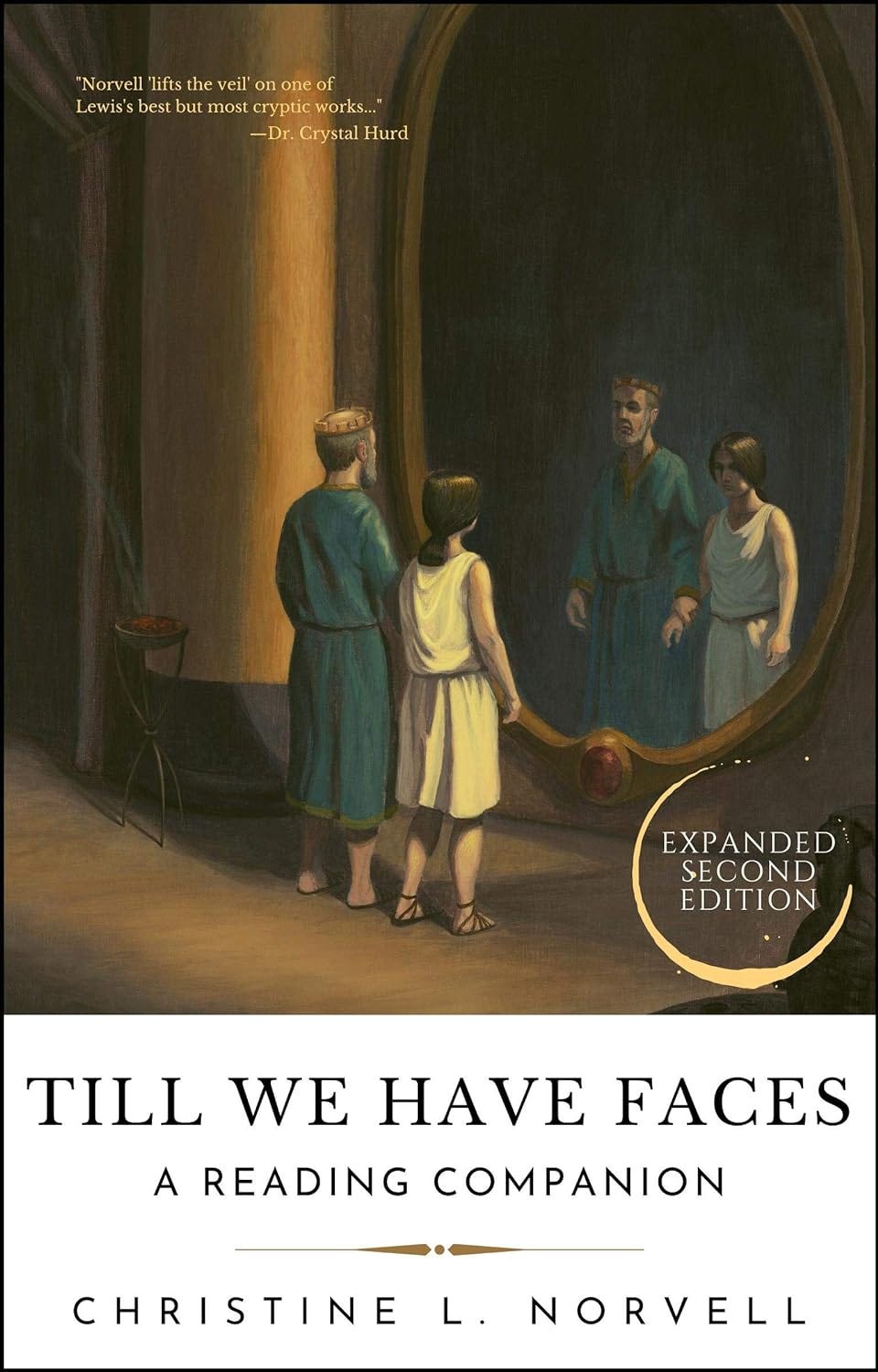
Perfect for beginners, this handy study guide for C.S. Lewis’s novel is a blend of summary and scholarly commentary. The second edition includes leading commentary from Lewis scholars as well as key parallels from Lewis’s other works like The Four Loves, Surprised by Joy, and An Experiment in Criticism. Each chapter includes discussion questions designed for students, teachers, book clubs, and church groups. Available at multiple online stores or at Amazon.
thanks!